Digital Marketing Dhaka logoCall now
Editorial Calendar · Dhaka

Editorial Calendar & Content Ops for Dhaka Brands

ঢাকার ব্র্যান্ডদের জন্য এডিটোরিয়াল ক্যালেন্ডার + কনটেন্ট অপারেশন

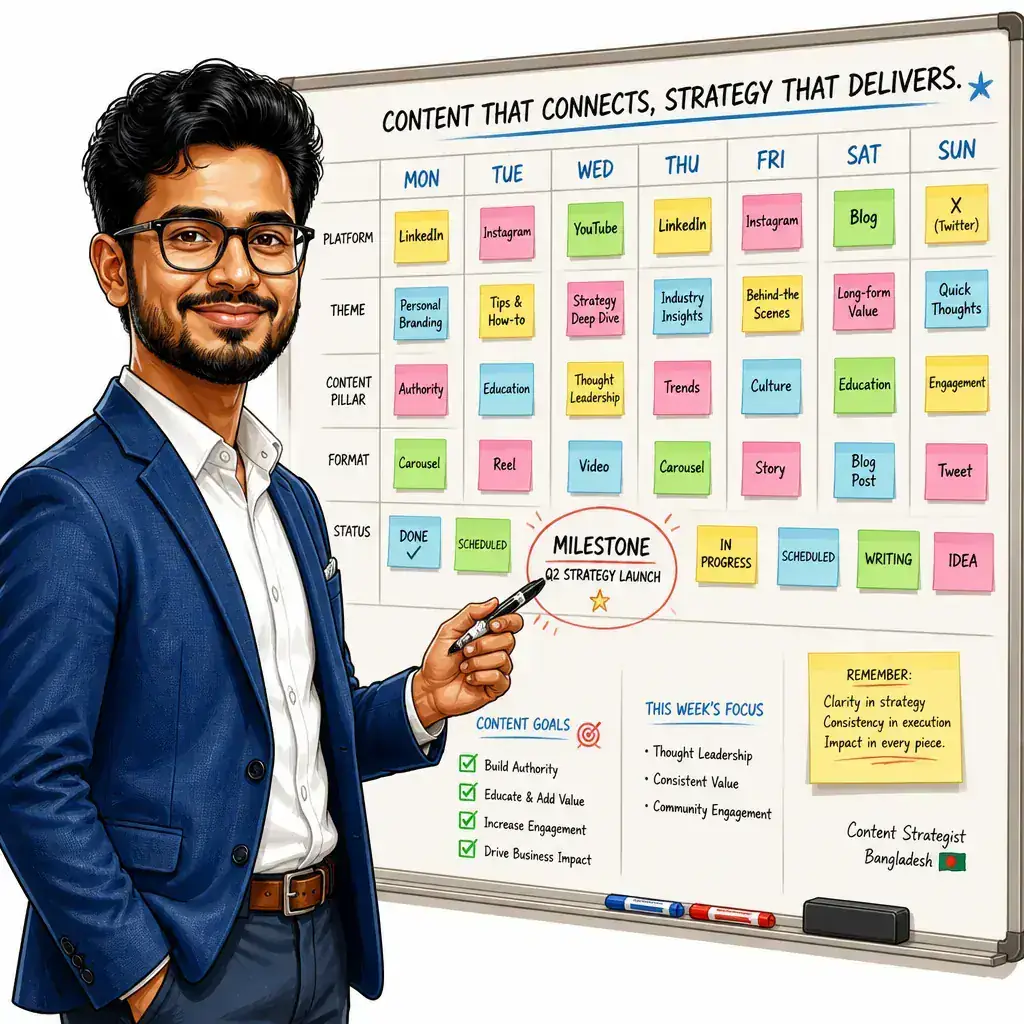
Editorial Calendar & Content Ops for Dhaka Brands — Digital Marketing Dhaka caricature illustration
SLAs, not vibes
কোয়ার্টারলি রিট্রো

Quarterly themes, monthly deliverables, weekly shipping — with SLAs, named owners, review windows and quarterly retros. A real content operation, not a Google Sheet nobody opens.

কোয়ার্টারলি থিম, মাসিক ডেলিভারেবল, সাপ্তাহিক শিপিং — SLA, named owner, review window, কোয়ার্টারলি retro সহ। আসল কনটেন্ট অপারেশন, Google Sheet নয়।

Quick answer

Editorial calendar — in one paragraph

An editorial calendar in Dhaka is a rolling 90-day operating plan for content — quarterly themes, monthly deliverables, weekly shipping cadence, named owners per piece and review SLAs. Digital Marketing Dhaka runs it in Notion or ClickUp, wired to a Bangla + English writer bench, video pipeline and monthly retros so nothing dies in draft.

ঢাকায় এডিটোরিয়াল ক্যালেন্ডার মানে — ৯০ দিনের rolling operating plan। কোয়ার্টারলি থিম, মাসিক ডেলিভারেবল, সাপ্তাহিক shipping, প্রতিটি পিসে named owner, review SLA। Notion/ClickUp-এ চালানো, বাংলা + ইংরেজি writer bench, ভিডিও pipeline, মাসিক retro — draft-এ কিছু মরে না।

Why Dhaka

Why this matters for Bangladeshi businesses

Most Dhaka content dies in the same three places: no plan (writer waiting for briefs), no owner (draft in Google Doc for two weeks), no review SLA (founder ghosts for a month). A calendar without ops is a decoration. Ops without a calendar is chaos. Both together is the difference between publishing 40 pieces a quarter and publishing 8.

ঢাকার বেশিরভাগ content তিনটি জায়গায় মরে: কোনো plan নেই (writer brief-এর জন্য অপেক্ষা), কোনো owner নেই (draft ২ সপ্তাহ Google Doc-এ), review SLA নেই (founder এক মাস ghost)। Ops ছাড়া calendar decoration। Calendar ছাড়া ops chaos। দুটো একসাথে quarter-এ ৪০ পিস বনাম ৮ পিস।

What's included

Every piece we ship in this engagement

01

90-day rolling calendar

Every piece — blog, video, reel, email, social post — plotted on a rolling 90-day view with owner, deadline, review-by date and channel.

02

Quarterly themes

Each quarter locked to 3-5 thematic pillars driven by business priorities (launch, campaign, seasonal). Everything published in the quarter ladders up.

03

Named owners per piece

Writer, editor, designer, approver — named on every task. No 'the team will handle it' entries.

04

SLAs for every stage

Brief in 2 business days, first draft in 5, review in 2, revisions in 3, publish in 2. Miss an SLA and the calendar flags it — nothing hides.

05

Notion / ClickUp setup

Full workspace configured — templates, views (writer, editor, client, exec), automations for status changes, weekly digest. Runs even if we leave.

06

Weekly stand-up + shipping cadence

15-min weekly ops call: what shipped, what's blocked, what ships next week. Nothing else. Async retro on Fridays.

07

Monthly performance review

First Monday of every month: what won, what didn't, what the next month's brief looks like. Data from GA4 + Search Console + social insights.

08

Quarterly retro + re-plan

End of every quarter: what worked, what didn't, what changes about themes/cadence/roles. Next 90-day plan drafted before the current one ends.

Our process

How we deliver it in Dhaka

01

Audit + workspace setup (Week 1)

Audit current cadence, tools and pain points. Notion or ClickUp workspace configured with templates and roles.

02

Quarterly plan (Week 2)

First 90-day plan drafted — themes, monthly deliverables, weekly cadence — signed off with leadership.

03

Launch + first sprint (Weeks 3-4)

First month of tasks loaded, briefs written, owners assigned. Weekly stand-ups begin.

04

Ongoing ops

Weekly stand-ups, monthly performance review, quarterly retro + re-plan. Managed by our content ops lead as a fractional service.

Deep dive

The details that decide the outcome

Why the SLA is the whole system

Every content operation that scales has one thing in common: hard SLAs at every handoff. Without them, a piece waits 4 weeks for a founder review that should take 2 days, and the calendar drifts by a month per quarter. With them, missed handoffs get flagged automatically and the team knows exactly where the bottleneck is. SLAs aren't bureaucracy; they're the load-bearing wall.

The quarterly theme is a forcing function

Without a quarterly theme, every meeting devolves into 'what should we write next'. With one — say, 'Q2 = SaaS onboarding' — briefs, videos, reels and emails all snap into place. Themes force alignment early, which saves 30-40% of the meeting time downstream.

Why the calendar lives outside Google Sheets

Google Sheets die because no one gets notifications, changes are invisible, and there's no relational structure between tasks and content. Notion / ClickUp treat each piece as a database record with owner, status, deadline and comment thread — so the calendar drives the work, not decorates the wall.

The monthly review is where strategy earns its keep

The first-Monday review isn't a status update. It's a decision meeting: which topics get more, which get killed, which formats to test next. Without it, content programmes drift into 'keep publishing what we've been publishing' — even after the data has changed.

Dhaka proof

What it looks like on the ground

A Banani-based EdTech company was publishing 3-4 pieces a month with 6 people involved and constant firefighting. We audited: no owner discipline, briefs written the day before publish, founder review taking 9-14 days. New setup: Notion workspace, 5 SLAs, weekly stand-up. Q1 output went from 11 pieces to 34 pieces with the same 6 people, and founder review time dropped from 11 to 2 days average. Two of the quarter's hero posts became the top-2 organic acquisition pages 4 months later.

বনানীর একটি EdTech কোম্পানি মাসে ৩-৪ পিস publish, ৬ জন involved, নিয়মিত firefighting। Audit: কোনো owner discipline নেই, brief publish-এর আগের দিন, founder review ৯-১৪ দিন। নতুন setup: Notion workspace, ৫টা SLA, সাপ্তাহিক stand-up। Q1 output ১১ থেকে ৩৪ পিস (একই ৬ জন), founder review time ১১ থেকে ২ দিন। quarter-এর ২টি hero post ৪ মাস পরে top-২ organic acquisition পেজ।

FAQ

Frequently asked questions

Notion or ClickUp — which do you recommend?

Notion for content-heavy teams who value writing UX; ClickUp for teams already using it for other ops. Both work. We set up either.

Do you run the calendar or teach us?

Both options — fractional content ops lead (we run it) or one-time setup + training (we hand over). Most brands start with the former, transition to the latter.

How is this different from a project management setup?

Content ops is a specialised subset — briefs, review cycles, SEO checklists, distribution templates and performance loops are baked in from day one. Generic PM tools don't have those primitives.

What if a founder is the bottleneck?

SLAs surface the bottleneck within one week. We work with founders to shift review from 'read carefully' to 'trust + spot-check', which usually recovers 5-10 days per piece.

Notion না ClickUp — কোনটা?

Content-heavy team-এর জন্য Notion; অন্য ops-এ ClickUp ব্যবহারকারী team-এর জন্য ClickUp। দুটোই কাজ করে।

Calendar আপনারা চালান নাকি শেখান?

দুটোই — fractional content ops lead (আমরা চালাই) বা one-time setup + training (hand over)। বেশিরভাগ brand আগের-টা দিয়ে শুরু করে।

সাধারণ project management setup-এর সাথে পার্থক্য কী?

Content ops specialised — brief, review cycle, SEO checklist, distribution template, performance loop day one থেকে। Generic PM tool-এ এসব primitive নেই।

Founder bottleneck হলে?

SLA এক সপ্তাহে bottleneck surface করে। Founder-দের সাথে review 'read carefully' থেকে 'trust + spot-check'-এ shift — সাধারণত পিস প্রতি ৫-১০ দিন recover।

Ready to ship this in your next 30 days?

Book a free 30-min content call. We'll audit your current content programme live and show you the biggest editorial, video and repurposing wins — no obligation.